

Pivot vs hinged shower door: which one, and when
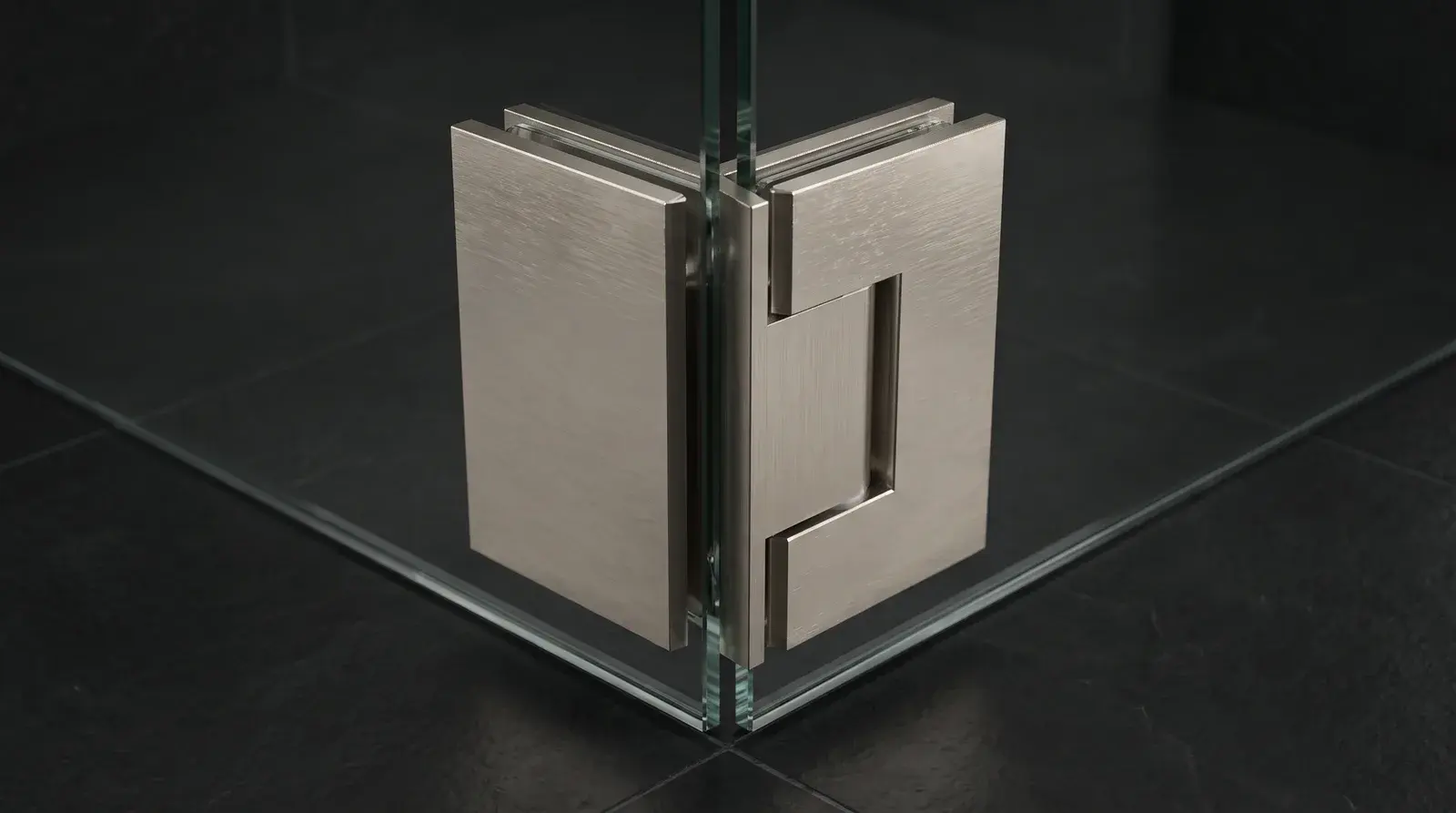
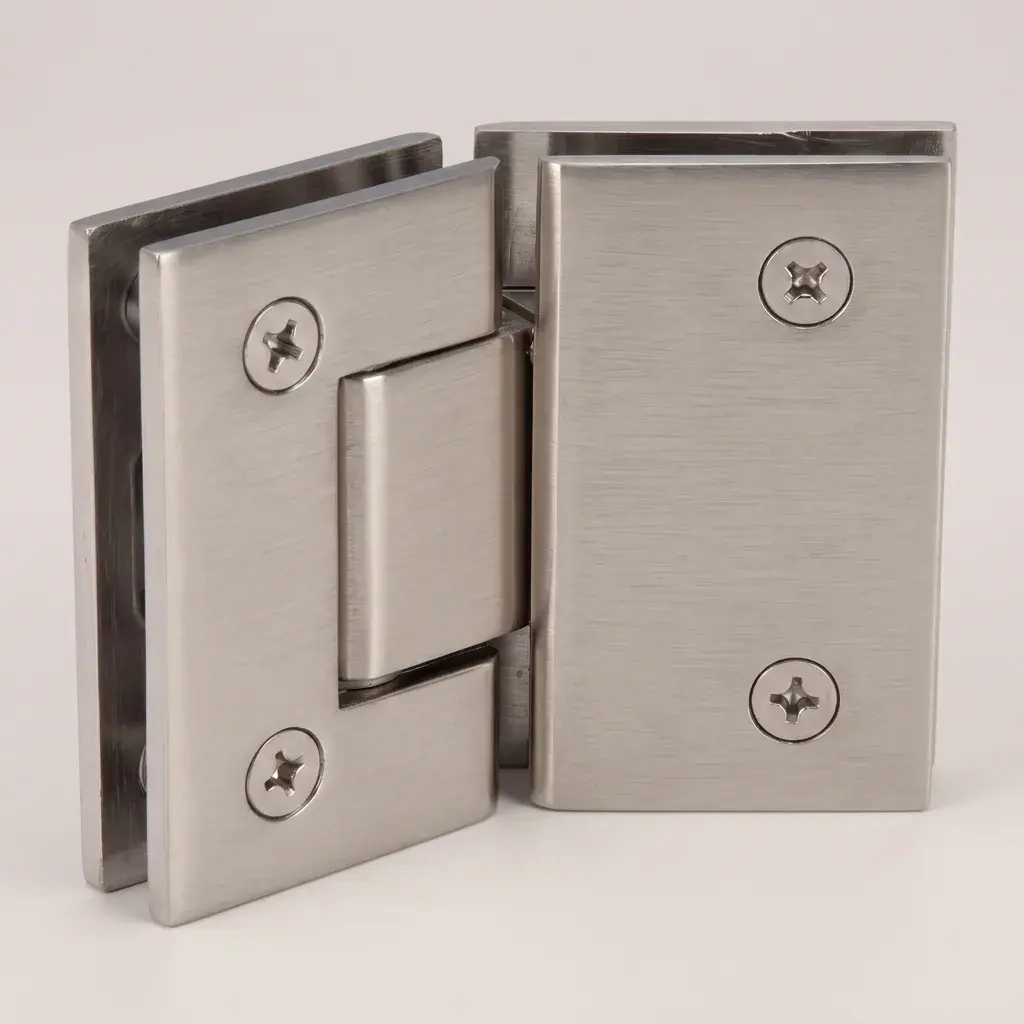
A hinged shower door hangs from its side on two or three hinges fixed to the wall or to a glass panel. A pivot shower door turns on two pins, one at the top and one at the bottom, so the weight goes into the floor and the header instead of the wall. Use hinges for most standard doors. Use a pivot when the door is heavier, taller or wider, or when there is no good wall to hang it from.
How a hinged shower door works
The hinges clamp the edge of the glass and hold the whole door from one side. On a frameless shower they come in two families:
- Wall mount, like the H-back or offset back hinge, when the door hangs from the wall.
- Glass-to-glass at 90°, 135° or 180°, when the door hangs from a fixed glass panel.
Our standard shower door hinges carry a door up to 80 lb and 28" wide per pair, and they pull the door closed on their own from about 20°. The heavy duty versions carry 110 lb with two hinges and 140 lb with three.
Because all of that weight hangs from one side, the wall or panel behind the hinges has to be solid. Wall mount hinges need blocking behind the tile, and glass-to-glass hinges need the fixed panel itself to be held firmly by clamps or a U-channel.
How a pivot shower door works
A pivot hinge set has a bottom pivot that sits on the curb or floor and a top pivot at the header, the ceiling or a wall adapter. The door turns on the line between them. The side of the door carries no load, so the hinge line no longer depends on the wall.
What we stock, all solid brass for 3/8" to 1/2" tempered glass:
- Pivot hinge: compact, mounts top or bottom with an inset mount and 7/16" clearance. A pair carries up to 100 lb and 31" wide.
- Heavy duty top and bottom pivot: self-closing from 15°. A pair carries up to 145 lb and 36" wide.
- 180° glass-to-glass pivot: for a door that pivots in line with a fixed panel, up to 100 lb and 31" wide.
- Standard pivot wall adapter: mounts the pivot to the wall where there is no panel to take it.
Pivot vs hinged, point by point
- Where the weight goes: hinges load the wall or the panel beside the door; a pivot loads the floor and the header.
- Door size: with our parts, hinges take up to 140 lb (three heavy duty hinges); the heavy duty pivot takes 145 lb and 36" wide per pair.
- Walls: hinges need a plumb, solid wall with blocking; a pivot works where the wall is weak, tiled over drywall or not there at all.
- Look: hinges put metal on the side of the door; pivots keep the side edge clean, with small fittings top and bottom.
- Swing: both can be set to swing in and out. A pivot can also sit in from the edge, so part of the door swings inward while the rest swings out.
- Install: hinges are the faster, more familiar install; a pivot needs a level curb or floor and a solid fixing at the top, and both pivots have to line up exactly.
When to choose a hinged door
- It is a standard shower door within the hinge rating, and the wall has blocking behind the hinge line.
- The door hangs from a fixed panel in a corner or an in-line layout.
- You want the quickest install and the easiest service later. A hinge is the most common part to replace and the easiest to match.
When to choose a pivot door
- The door is tall, wide or heavy, close to or past what a pair of hinges carries.
- The wall beside the opening can't take the load: tile over drywall with no blocking, a glass wall or a stone slab.
- The design calls for a clean side edge with no visible hinges.
- It is an interior glass door or partition rather than a shower, where pivots are the usual choice.
What about sliding?
If the door can't swing at all because a toilet or vanity is in the way, look at a sliding system instead. We cover the options in 4-roller, 8-roller or barn door, and the parts are in sliding door systems and barn door shower hardware.
Before you order
- Work out the door weight from the size and glass thickness. Our glass weight reference has the weight per square foot.
- Compare it with the ratings above and leave a margin.
- For hinges, confirm blocking and plumb along the hinge line, and pick the type and angle from the layout.
- For a pivot, confirm the curb or floor is level and there is a solid fixing at the top, or order the wall adapter.
- Send the hole and notch positions to the glass shop before tempering. They can't be changed after.
For a deeper look at hinge types, see shower door hinges, explained. Every hinge and pivot here is stocked at our Medley, FL warehouse in Chrome Polished, Brushed Nickel, Matte Black and Satin Brass. Order by 1 PM ET for same-day dispatch, or pick up at the counter.