


Shower door hinges, explained: which hinge for which door
Most frameless shower door problems trace back to one decision: the hinge. A door that sags, drifts open, or clips the tile was usually hung on the wrong hinge type, the wrong count, or a hinge rated for thinner glass than what showed up on the truck. The glass is rarely the issue.
This guide covers the types of shower door hinges used on frameless enclosures, what each one is for, and the rules of thumb that keep a door swinging true. Exact ratings vary by manufacturer, so check the spec sheet before you commit a layout.
What a frameless hinge has to do
A frameless shower door hinge clamps the glass between two plates and carries the full weight of the door on two or three small contact points. There is no frame spreading the load, which is why hinge selection matters more here than anywhere else in the enclosure. Match three things to the job: mounting condition, glass thickness and weight rating.
Wall to glass shower door hinges
Wall-mount hinges attach to the stud wall or a solid substrate and hold the door on the hinge side. They are the default for a single door that hinges off a tiled wall.
Standard wall-mount hinge
Mounts flush to the wall with a back plate and swings the door in both directions, usually with a self-closing zone near center. Use it when the wall is plumb and the plate can sit flat on the tile.
H back plate hinge
An H back plate hinge uses a taller plate that spreads the load across more wall and gives you anchor points above and below the pivot. Specify it when the wall is questionable, the door is heavier than average, or the stud sits only partly behind the hinge.
Offset back hinge
An offset back hinge moves the pivot out from the wall so the door clears a tile lip, a bullnose edge or a tub deck. It is also the fix when the door needs to sit proud of a jamb to align with a fixed panel. The offset adds leverage on the wall, so treat it as a heavier-duty application even on a light door.
Glass to glass shower door hinges
When the door hangs off a fixed panel instead of a wall, you need a glass-to-glass hinge. The angle between panel and door decides which one.
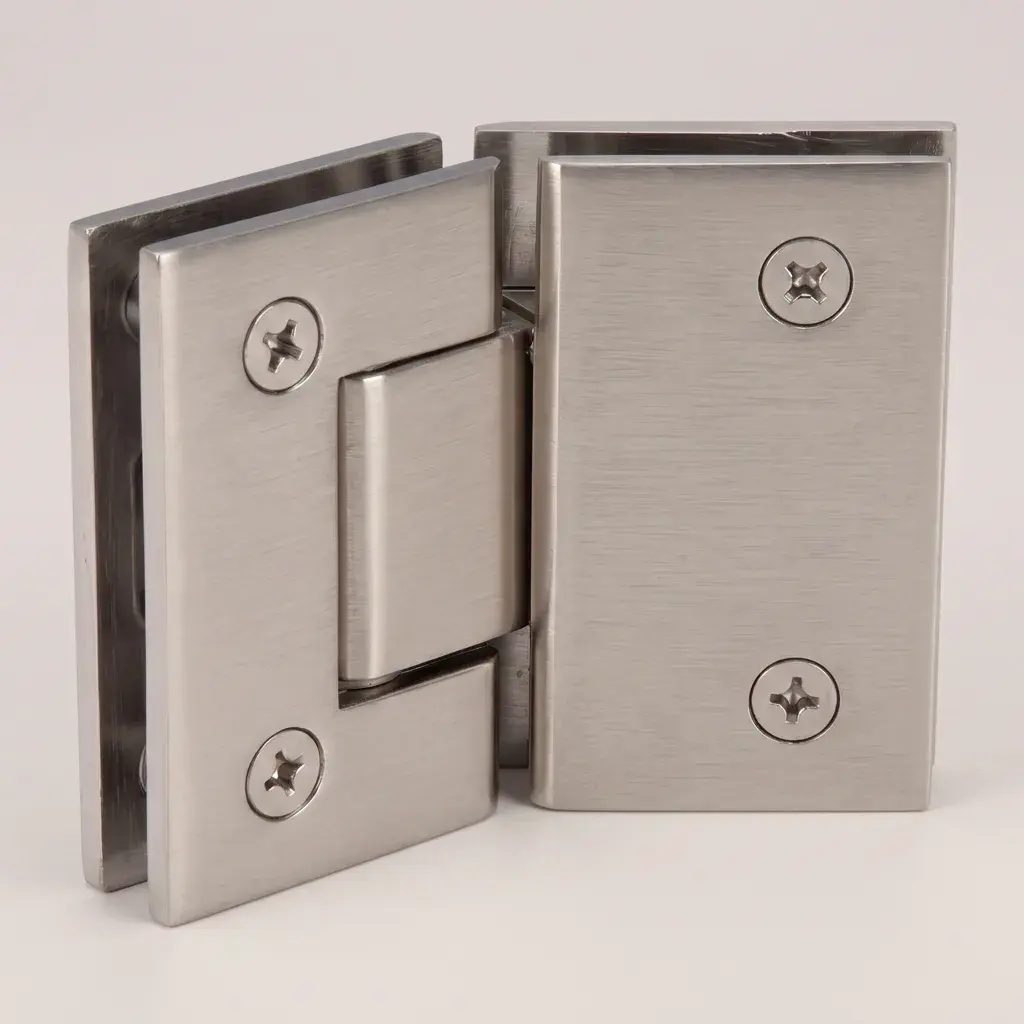
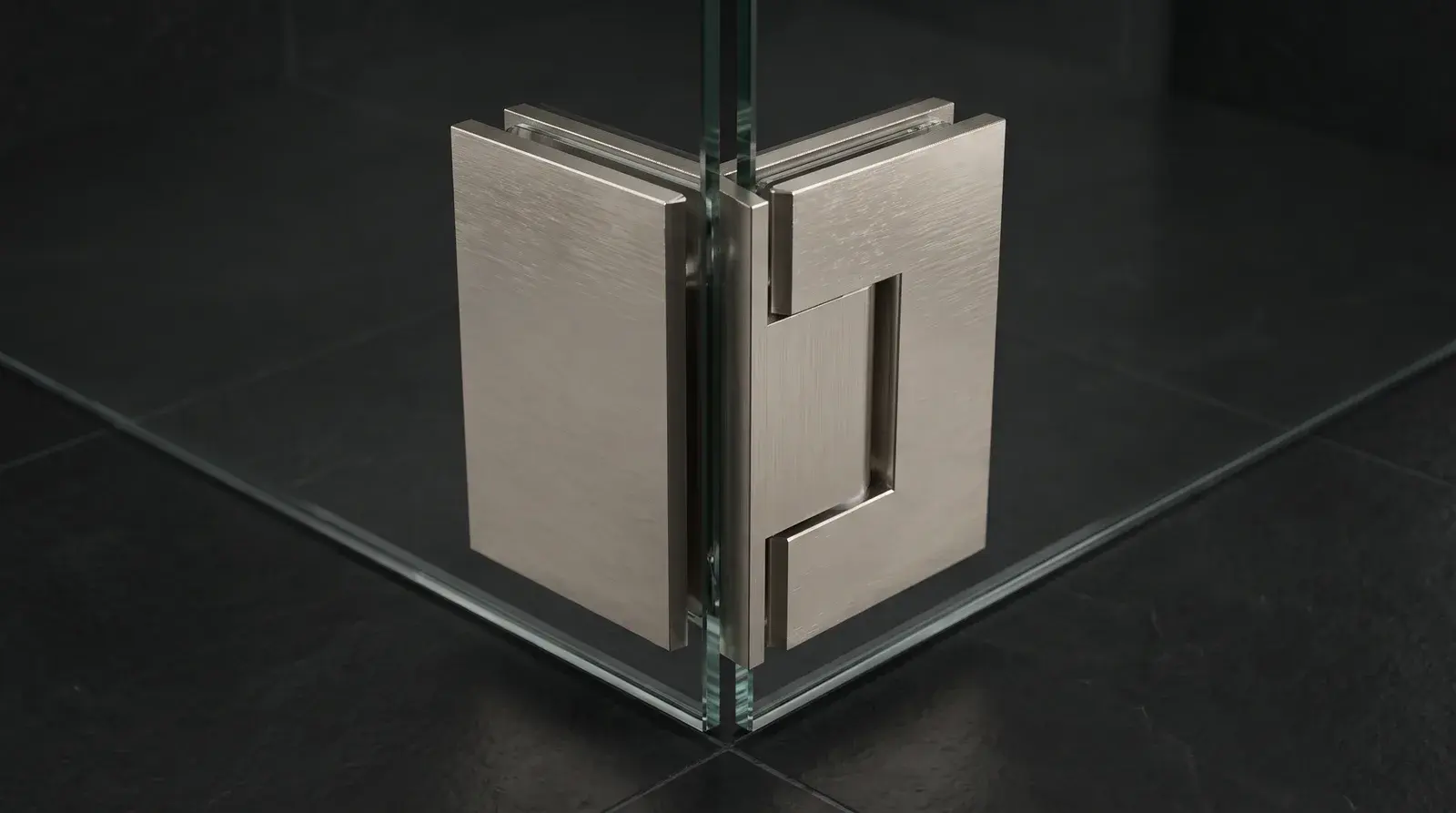
- 90 degree. The door meets the panel at a right angle, as in a corner enclosure where the fixed panel returns on the other side. The 90 degree hinge is the workhorse for this layout.
- 135 degree. Neo-angle enclosures where the door and panels meet at 135 degrees. The 135 degree hinge lets a neo-angle door swing without a wall.
- 180 degree. Door and panel in line, with no wall on the hinge side. Use a 180 degree hinge. Do not substitute a wall-mount hinge on a fixed panel; the plate is not designed to clamp glass on its back.
Glass-to-glass hinges put the whole door load onto the fixed panel, so the panel needs a header, a top clamp or a bracing bar to the wall. A panel held by U-channel alone will rack under a door.
Pivot shower door hinges
Pivot hinges mount at the top and bottom edge of the door rather than the side. The door rotates around a vertical axis close to the hinge edge, which keeps the swing tight and reduces the moment on the glass.
A top and bottom pivot hinge set pairs with a header bar, or with a pivot wall adapter that ties the top pivot to the wall when no header is used. Pivots are the go-to on tall or wide doors and on layouts where a side-mounted hinge would land on a bad wall.
Two things to get right: floor and header must be parallel, and the bottom pivot needs a solid substrate. On a sloped curb, plan for the offset in the bottom fitting or the door will not close square. The full range is under pivot hinges.
Heavy duty versus standard
Standard frameless hinges are generally rated around 80 to 120 lb per pair for 3/8 inch glass. Once you move to 1/2 inch glass, an oversized door, or a door carrying a full-height pull and a towel bar, you are usually into heavy duty glass shower door hinges.
Heavy-duty models use thicker plates, a larger pin and more clamp area, and exist in every mounting style: a heavy duty H back plate hinge for wall-mount, heavy-duty 90 degree glass-to-glass, and a heavy duty top and bottom pivot set. If the door weight plus hardware lands within about 20 percent of the standard rating, step up. Ratings are per pair and assume correct installation; check the spec sheet for the exact number.
Plug-in and non-glass-cut hinges
Most frameless hinges need a notch cut into the glass so the plates sit flush with the edge. Plug-in, or non-glass-cut, hinges clamp to a plain edge with no notch. The heavy duty 90 degree plug-in hinge is one example.
They are useful when the glass was fabricated without notches, when replacing a hinge on an existing door, or when glass lead time is the bottleneck. The clamp does all the work, so torque matters and the edge must be flat and free of chips.
Hinge count and placement
- Two hinges for doors under about 30 inches wide and 80 lb. Three above that, or whenever the door is 1/2 inch glass.
- Top hinge roughly 8 to 10 inches down from the top edge, bottom hinge 8 to 10 inches up from the bottom. A third hinge sits at center.
- Keep the hinges in a straight vertical line. A quarter inch of offset is enough to bind the door.
- Clear the curb by 1/2 inch minimum, on both sides of the swing for reversible hinges.
- On glass-to-glass, the fixed panel should be at least as thick as the door and braced at the top.
Glass thickness compatibility
Nearly every frameless hinge ships in a 3/8 inch and a 1/2 inch version, or with interchangeable gaskets. Match the gasket to the glass. A 1/2 inch gasket on 3/8 inch glass will clamp, but it creeps under load and the door drops within months. Most 1/2 inch doors belong on heavy-duty hinges regardless of width, because the thicker glass adds roughly a third to the door weight.
Finishes
Finish does not change function, but it changes lead time and matching. Chrome and brushed nickel are stocked in nearly every hinge type. Black shower door hinges are now the most requested finish on new work, and matte black is standard across most heavy-duty and pivot lines. Brushed brass and gold are available on fewer models, so confirm the whole set (hinges, clamps, pull, header) is in the same finish family before you quote.
Common spec mistakes
- Ordering a wall-mount hinge for a door that hangs off a fixed panel.
- Standard hinges on 1/2 inch glass because the door looked small on the drawing.
- Two hinges on a 32 inch door with a full-height pull.
- Forgetting the notch. Standard hinges need a cutout; plug-in hinges do not. Mixing them up means a second glass order.
- An offset hinge without checking the wall anchor for the extra leverage.
- Mixing finishes across hinges, clamps and pulls from different lines.
- Skipping the fixed-panel brace on a glass-to-glass layout.
Singular stocks wall-mount, glass-to-glass, pivot and heavy-duty shower door hinges in Miami, with spec sheets for every model, alongside the rest of the shower door hardware line. Send drawings and glass thickness before pricing and we will confirm hinge type, count and finish for the job.