
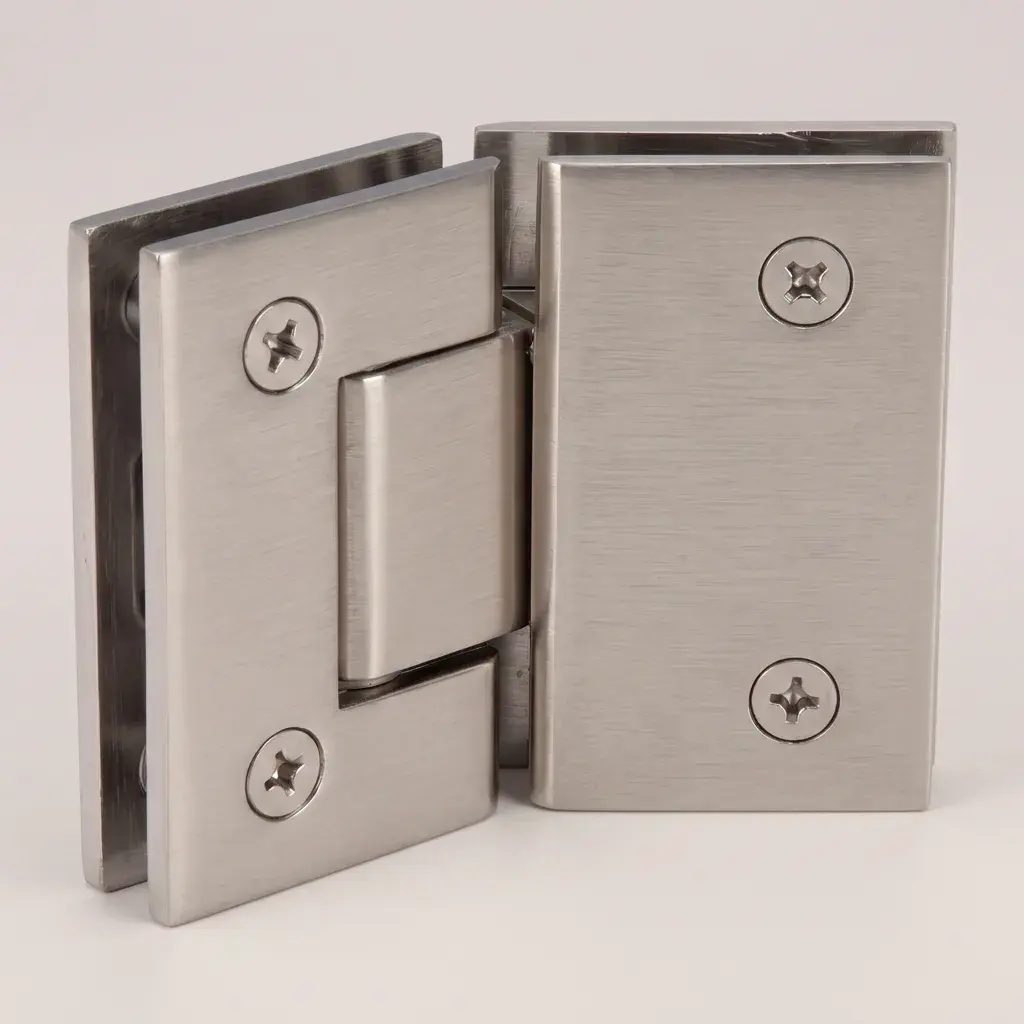


Hydraulic patch fittings: the frameless commercial glass door without a floor closer
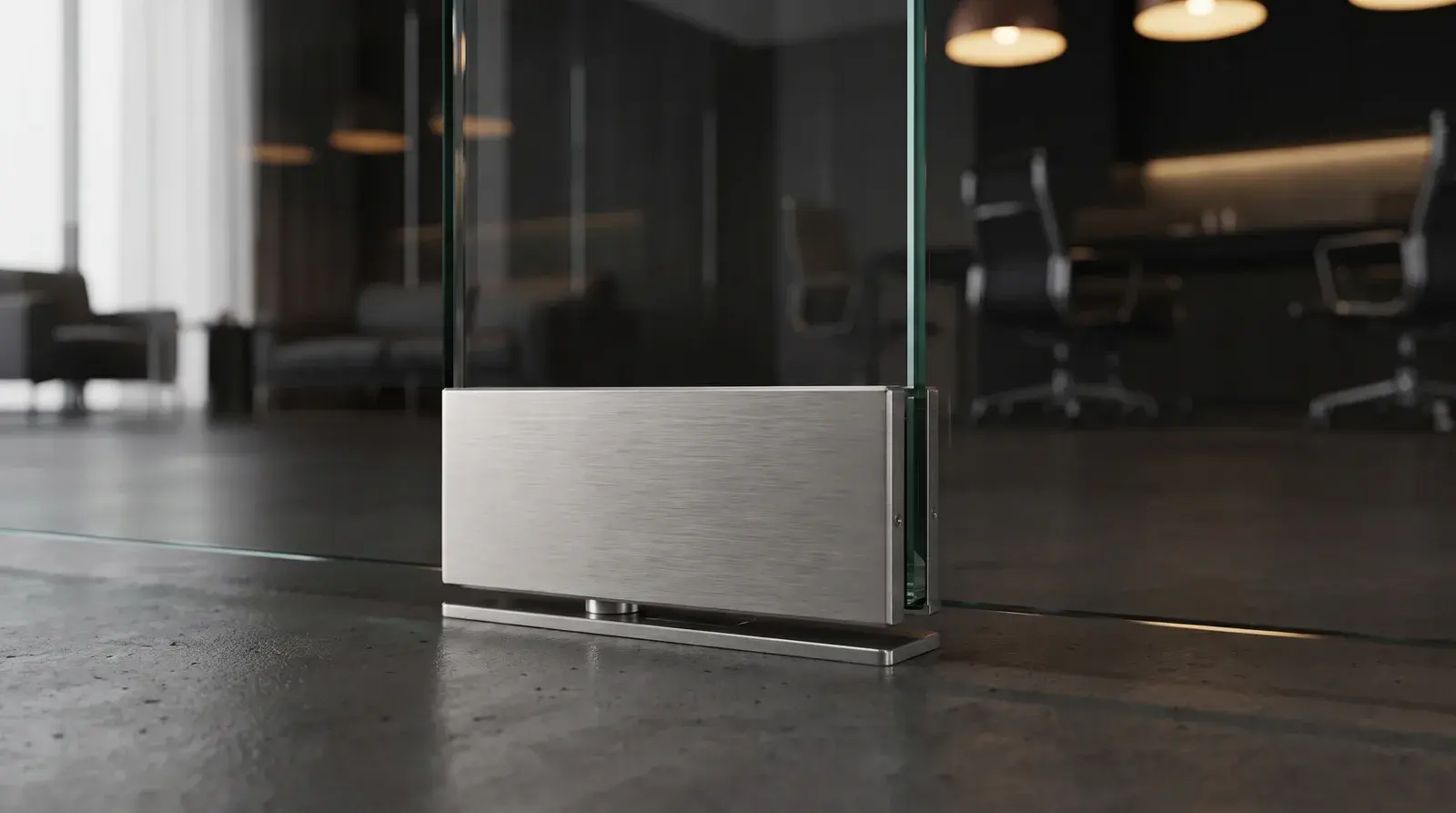
Most frameless glass door problems on a commercial job come down to one question: where does the closer live? For decades the answer was the floor. Cut a pocket, set a floor closer, hang the leaf on top and bottom patch fittings. It is still the right call on heavy exterior entrances. But much of today's work is interior, in existing buildings, on slabs nobody wants to cut. That is where the hydraulic patch fitting earns its place.
Three ways to hang a frameless glass door
Floor closer with top and bottom patches
The closer body sits in a cement case recessed into the slab. A spindle engages a bottom patch on the glass; a top patch pivots off the header or a transom fitting. It carries the heaviest leaves, gives the smoothest control and hides everything. The cost is the floor: a saw-cut pocket, a cured grout bed, and in a retrofit, a survey to make sure there is nothing in the way. On a post-tensioned slab, cutting is often off the table entirely.
Hydraulic patch fitting
A hydraulic patch, sometimes sold as a hydraulic patch door kit, moves the closing mechanism into the bottom patch itself. The unit clamps to the bottom corner of the glass, sits on a floor pivot plate that is surface-mounted or set flush with a shallow recess, and closes the door with its own hydraulic cylinder. The top corner runs on a standard top patch and pivot. No cutting, no cement case, no waiting for grout.
Overhead concealed closer
The closer goes in the header. The glass hangs on a top arm and a bottom pivot. It keeps the floor clean, but it needs a header deep enough for the closer body, which is fine in a new storefront frame and a problem in an existing ceiling line or a slim all-glass transom.
Where hydraulic patches fit
- Retail interiors and mall fronts where the landlord owns the slab and will not allow a floor cut.
- Office partitions and conference room doors, where a self-closing leaf is wanted without a full floor closer.
- Tenant improvements in occupied buildings, where saw cutting means dust, noise and a shutdown nobody budgeted.
- Post-tensioned or radiant-heated slabs, where cutting risks tendons or tubing.
Glass Magazine's 2026 Top 50 Glaziers report notes that retrofit, renovation, tenant improvement and facade replacement work remain important for large contract glaziers, offsetting softness in new private commercial construction. Hardware that installs without touching the slab answers that workload directly.
Limits to check before you spec
Hydraulic patches do not replace floor closers across the board. Each manufacturer publishes its own envelope, so read the sheet, but the general shape is consistent:
- Glass thickness: 1/2 in. tempered is the typical leaf. Some units accept 3/8 in. or 5/8 in. with different gaskets or clamp plates.
- Door weight and width: the closer is sized for interior leaves. Wide or tall doors, or laminated glass with extra mass, push past the rating quickly. Do the weight calculation, not a guess.
- Hold-open: most units offer a 90-degree hold-open, useful for deliveries and cleaning. Confirm whether it is selectable or fixed on the model you are ordering.
- Closing speed: adjustable through a valve on the unit, usually reachable without pulling the glass. Latching speed may be a separate adjustment or none at all.
- Swing: single-action or double-action. Double-action needs clearance both sides and a stop the door can find on its own.
What the glass fabricator needs
The notch and hole layout must match the specific unit. Send the fabricator the manufacturer's fabrication drawing, not a generic patch template:
- Corner notch dimensions for the bottom hydraulic patch, which is larger than a standard bottom patch.
- Hole size and spacing for the through-bolts on both patches.
- Edge clearance so the notch does not sit too close to a polished edge, which weakens tempered glass at the corner.
- Pull handle and lock holes in the same drawing, so everything is cut before tempering. Nothing gets drilled after.
Order the hardware before releasing the glass. Changing the patch after tempering means new glass.
Pivot alignment and the header
A frameless pivot door only closes reliably if the top and bottom pivot points sit on one vertical line. With a hydraulic patch, the floor pivot plate sets the bottom point and the top patch or a heavy-duty top and bottom pivot set sets the upper point. Plumb them with a laser, not by eye, and shim the floor plate on an uneven slab.
The header carries real load. A top patch pivoting off a drywall soffit with no blocking will move, and the door will rub within a month. Use steel or solid blocking in the header, or land the top pivot on a transom fitting clamped to a fixed glass panel above the door. Check the commercial pivot door hardware range for top pivots and transom fittings matched to the patch.
ADA opening force
Under the 2010 ADA Standards, section 404.2.9 caps the force to open interior hinged doors at 5 lbf, measured as the continuous force to swing the door open, not the initial push to break inertia. The limit does not apply to unlatching, and the ADA Standards set no opening-force figure for exterior hinged doors, though local codes often do. A hydraulic patch set to close a wide leaf firmly can exceed 5 lbf on the opening stroke. Measure with a door force gauge after adjustment, and be prepared to accept a slower, softer close on doors that must comply.
Fire and egress
Frameless tempered glass doors are not fire-rated assemblies. If the opening sits in a rated corridor wall or a rated stair enclosure, a frameless door is the wrong product and no hardware will change that. On egress doors, confirm with the AHJ whether a pull-only door is acceptable or panic hardware is required by occupancy and load. Locks on egress doors must release with a single motion and without a key from the egress side.
Common failure modes
- Leaking hydraulic unit: oil stains on the floor plate or a door that suddenly swings free. The cylinder is not field-serviceable; replace the patch.
- Misaligned pivots: the door drifts open or slams, rubs the jamb glass, or refuses to latch. Nearly always a header or floor plate that was not plumb on day one.
- Door drop: the leaf sags at the strike side. Look for clamp plates that lost torque, a gasket that has crept, or a header moving under load.
Maintenance
Twice a year, check clamp bolt torque on both patches, inspect the floor plate for oil, confirm closing speed against the original setting and test opening force where ADA applies. Note the model on the closeout documents so facilities can order a matching replacement instead of a lookalike with a different notch.
Spec checklist
- Door size, glass thickness and calculated leaf weight, checked against the unit rating.
- Single or double action, hold-open at 90 degrees yes or no.
- Slab condition: post-tensioned, radiant, or clear for a shallow recess.
- Header construction and blocking, or a transom fitting on fixed glass.
- Manufacturer fabrication drawing issued to the glass shop, including pull and lock holes.
- Pull style: back-to-back ladder pull, offset pull or a lockable handle from the commercial pulls and handles range.
- ADA opening-force target and who is measuring it.
- Fire rating of the wall and egress hardware requirements confirmed with the AHJ.
- Finish matched across patches, pivots and pulls.
Singular Glass Hardware stocks hydraulic patch kits, top and bottom pivots, transom fittings and commercial pulls in Medley, Florida, with spec sheets and fabrication drawings available on each product page for the fabricator and the installer. If a door falls outside the published limits, we will say so and point you to a floor closer.